|
|
|||||||||||||||||||||||||||||||||||||||||||||||||
|
|||||||||||||||||||||||||||||||||||||||||||||||||
|
As the cash flows of many resorts around Asia have been
affected by the recent global events stemming from the terrorist attacks in the
US, many resort owners are wondering about the value of their resorts.
Historically, resort values in Asia have been estimated on the basis of
replacement cost, comparable sales transactions or various direct capitalisation
approaches. Although these approaches are widely accepted throughout Asia by
banks, investors and developers, they often completely ignore the future earning
potential of resorts, the current and future condition of the markets in which
the resorts operate and the current shortfall of debt capital and high return
requirements of active equity investors in Asia. |
|||||||||||||||||||||||||||||||||||||||||||||||||
|
As resort hotels differ from urban hotels in many ways, a
good understanding of the factors that could impact the future earning potential
of a resort is especially important when valuing a resort in Asia. |
|||||||||||||||||||||||||||||||||||||||||||||||||
|
Many developed resort destinations have good infrastructure,
such as a good road network, an educated work force and water and power
supplies. Less developed destinations, however, usually do not have such
infrastructure in place. This impacts the future development and competitive
level of such destinations in comparison to more developed destinations within
the region. |
|||||||||||||||||||||||||||||||||||||||||||||||||
|
Resort destinations such as Phuket and Bali have become
popular global tourist destinations due to their excellent accessibility – they
provide a network of direct international flights from various key feeder
markets. Resort destinations with limited accessibility, on the other hand, find
it difficult to compete with such destinations. As a consequence, they generally
rely on domestic and highly discounted wholesale demand. |
|||||||||||||||||||||||||||||||||||||||||||||||||
|
A large proportion of the resort hotels in Asia were
developed prior to the 1990s and only a few resort owners have carried out
necessary works to maintain their resorts at an international standard.
Therefore, there is a relatively limited inventory of well-maintained
international standard resort guestrooms in the region, which is likely to
negatively impact the positioning and level of competitiveness of the resorts. |
|||||||||||||||||||||||||||||||||||||||||||||||||
|
Furthermore, many resort destinations are affected by strong monthly seasonality cycles. During high season months, many resorts achieve occupancy levels in excess of 80%. However, during low season months, the same resorts may only achieve an occupancy level of say 50%. However, destinations with good accessibility and a good inventory of guestrooms have more opportunities and available market segments to attract demand during shoulder and low season months. All the above factors cause cash flows and profitability
levels to fluctuate. Consequently, both lenders and investors perceive resort
investments in Asia as risky, which can result in rapidly changing interest
rates and reasonably high investment yield requirements. |
|||||||||||||||||||||||||||||||||||||||||||||||||
|
In evaluating a property to assess its open market value, the
professional valuer has three approaches from which to select: the cost, sales
comparison and income capitalisation approaches. These approaches to value and
the valuation methodology set out hereafter may be applied to the valuation of
both existing and proposed resorts. |
|||||||||||||||||||||||||||||||||||||||||||||||||
|
The Cost Approach estimates market value of a resort by computing the current cost of replacing the property and subtracting any depreciation resulting from one or more of the following factors: physical deterioration, functional obsolescence and external (or economic) obsolescence. The value of the land, as though it were vacant and available, is then added to the depreciated value of the premises in order to produce a total value estimate. Whilst the cost approach may provide a reliable estimate of
value for newly constructed resorts, it is not the case for older properties. As
assets age and begin to deteriorate, the resultant loss in value becomes
increasingly difficult to quantify accurately. Many resort destinations in Asia
were developed ten to fifteen years ago and at highly inflated prices. As such,
many resort construction costs lack transparency or are incomplete and should be
analysed with caution. However, a prudent valuer should also take the cost
approach into consideration so as to gain an indication of the cost likely to be
incurred upon entry into the marketplace. |
|||||||||||||||||||||||||||||||||||||||||||||||||
|
The Sales Comparison Approach estimates the value of a resort
by comparing it to similar properties recently sold on the open market. To
obtain a supportable value estimate, the sales price of a comparable property
should be adjusted to reflect any dissimilarity between the comparable resort
and the subject resort. However, this approach to value has limited usage in
Asia due to the lack of recent resort hotel transactions in the region. |
|||||||||||||||||||||||||||||||||||||||||||||||||
|
Knowledgeable buyers of hotels generally base their purchase decisions upon economic factors, such as forecast net income and return on investment. The cost and the sales comparison approaches are therefore given minimal weight in the hotel valuation process, apart from providing, when applicable, an estimate of the cost to enter the marketplace either through newly constructed properties or acquisitions. The income capitalisation approach takes a resort’s forecast net income before debt and allocates these future benefits to the mortgage and equity components based on market rates of return and loan-to-value ratios. Through a discounted cash flow and income capitalization approach, the value of each component is calculated. The total of the mortgage component and the equity component equals the value of the property. Although historically applied only on a limited scale in
Asia, our experience with active potential hotel buyers and sellers in Asia
indicates that the income capitalisation approach is now becoming more widely
accepted in the regional marketplace. Furthermore, through the accurate build-up
of cash flows and the application of realistic investment parameters, the value
derived through the income capitalisation approach is reflective of what a
likely buyer is willing to pay for the resort asset. For this reason, the income
capitalization approach produces the most supportable value estimate and is
generally given the greatest weight in the hotel valuation process. |
|||||||||||||||||||||||||||||||||||||||||||||||||
|
In arriving at the value of a resort using the income
capitalization approach,
|
|||||||||||||||||||||||||||||||||||||||||||||||||
|
Due to the somewhat unique characteristics of resort markets, it is necessary to carry out detailed market research to support the cash flow projections of a resort. Fieldwork is undertaken to gain a thorough understanding of the market area and the demand and supply dynamics in which the resort operates. The following areas are thoroughly researched and analysed
during Step One: |
|||||||||||||||||||||||||||||||||||||||||||||||||
|
The macro- and micro climate in which a resort operates is an
important consideration in forecasting resort demand and cash flow potential.
This overview analyses the political, economic and social environment in which
the resort operates to ascertain whether the market area is likely to experience
future growth or decline. |
|||||||||||||||||||||||||||||||||||||||||||||||||
|
With many international investors and hotel operators seeking
resort development opportunities throughout the region, competition is likely to
increase. Resort destinations with good accessibility, such as Phuket and Bali,
are likely to continue to benefit from having an extensive international network
of flights from key feeder markets in Europe and Asia. In the case of an
emerging resort destination, its level of accessibility is likely to have a
serious impact on its future growth potential. It is therefore vital that a
comprehensive analysis of future developments that could impact a destination’s
accessibility be undertaken. |
|||||||||||||||||||||||||||||||||||||||||||||||||
|
As resort destinations in Asia were largely developed 10 to
15 ago, the level of development in many instances is limited and the hotel
inventory of a poor quality. Better accessibility is likely to lead to the
development of more upmarket and international standard resorts, which is likely
to enable a destination to reposition itself from a reasonably low-end or budget
destination to a mid- or higher market destination. However, the level of new
resort development and infrastructure development, such as airports, roads,
power and water supply lines, is likely to have a long-term impact on the
overall positioning and development potential of the destination. |
|||||||||||||||||||||||||||||||||||||||||||||||||
|
A comprehensive study is done of the historic tourism and hotel market performance in order to assess the historic growth / development of the destination. Information pertaining to visitor numbers, seasonality trends, average length of stay, key feeder markets and historic levels of hotel supply and demand is analysed. The purpose of the research set out in Step One is to
establish the current characteristics of the market area. Following this, a
conclusion is drawn on how the market area is likely to develop in the future.
|
|||||||||||||||||||||||||||||||||||||||||||||||||
|
The occupancy and average room rate projections for the
resort comprise the basis of the ten year forecast of income and expense. |
|||||||||||||||||||||||||||||||||||||||||||||||||
|
The methodology employed first quantifies the base level of demand in the competitive group of resorts and then forecasts the changes in supply and demand throughout the projection period to arrive at a projection of market-wide occupancy. The projection of market-wide occupancy considers base demand
growth and latent demand, including unaccommodated and induced demand. The
projection of base demand growth considers the points set out in Step One.
However, to support future demand growth analysis, interviews should be
undertaken with prominent airlines and tour operators to ascertain the likely
future development of air capacity and tour operator interest in the
destination. Unaccommodated demand is a form of excess demand and refers to
individuals who are unable to secure accommodation in the market area. For many
resort destinations, unaccommodated demand exists in the high season months,
when many resorts operate at high occupancy levels. Induced demand refers to the
additional room nights created through the introduction of a new demand
generator in the market area. As resorts themselves in many instances are the
main demand generators in the market area, the opening of a new resort is likely
to induce demand to the market area. |
|||||||||||||||||||||||||||||||||||||||||||||||||
|
Following the projections, a penetration analysis is
undertaken to project how the subject resort will be positioned within the
market in terms of both occupancy and average room rate. A penetration analysis
by market segment is used to project the future occupancy performance of the
subject resort against the market. The penetration factor is calculated by
dividing a resort’s fair share by its actual share. A resort with a penetration
of 110% is performing above its fair market share. This exercise requires an
in-depth understanding of the economic factors that influence each segment of
demand, including seasonality constraints, maximum monthly occupancy levels,
average length of stay, and the economic outlook for each key feeder market. In
addition, to forecast the operational positioning of each resort within the
competitive market, an in-depth understanding of the current and future levels
of competitive supply, including an assessment of the likely impact of brand
strengths, competitive facilities and location on the performance of resorts, is
required. In the case of undeveloped or emerging resort destinations, such as
Krabi and Nha Trang, where there is limited base demand, comparable regional and
international resort destinations are used as benchmarks. Adjustments are then
made for the subject market area, which reflect the resort’s accessibility,
hotel supply and other market specifics. |
|||||||||||||||||||||||||||||||||||||||||||||||||
|
In order to take into consideration the changes in market mix and seasonality in many resort markets, the subject resort’s weighted average room rate is projected following an analysis of the resort’s seasonal average room rate by market segment. Resorts in the region are typically characterised by the following market segments: FIT (full independent traveller), MICE (Meeting, incentive, conference and exhibition) and Wholesale (tour operator business). The average room rates of most resorts in the region vary significantly depending upon the following criteria: Seasonality; Accessibility; Brand Strength; Star rating / quality of facilities. During high season months, resorts capitalise on their popularity and maximise their average room rate potential within the Wholesale and FIT segments. During shoulder and low season months, on the other hand, resorts focus on attracting MICE demand and offer promotional discounts to maintain business in the FIT and Wholesale segments. Resorts located in destinations with good accessibility from either long- or short-haul markets are able to attract higher paying FIT and MICE segments whilst destinations with poor accessibility tend to attract lower paying Wholesale demand. Therefore, the average room rates achieved are generally higher in better-connected resort destinations. Resorts with strong brand recognition in key feeder markets and a global reservation system are likely to be able to attract higher paying demand. Furthermore, such resorts are likely to be able to capitalise on global loyalty or reward programmes. The quality and mix of facilities at a resort significantly
impacts the average room rate potential of a resort. Resorts with good
international standard facilities, in terms of guestrooms, food and beverage
outlets and recreational activities are likely to be able to achieve a rate
premium over resorts with inferior facilities. Newly opened resorts or recently
refurbished resorts are likely to capitalise on such premiums. |
|||||||||||||||||||||||||||||||||||||||||||||||||
|
Based on the occupancy and average room rate projections of a
resort, as well as the anticipated market positioning of its food and beverage
outlets and other departments, such as the spa and conference and meeting
facilities, a ten-year projection of income and expense is prepared. Using
actual operating data from the subject resort, or in the instance of a resort
feasibility study, from comparable resort facilities, expense estimates
corresponding to the projected level of activity and the overall quality of the
hotel are developed. In forecasting revenues and expenses for a hotel, a fixed
and variable component model should be used. The methodology of such a model is
based on the premise that hotel revenues and expenses have one component that is
fixed and another that varies directly with occupancy or facility usage. A
projection can be made, by taking a known level of revenue or expense and
calculating the fixed and variable components. The fixed component is adjusted
only for inflation, whilst the variable component is also adjusted for the
percentage change between the projected occupancy and facility usage that
produced the known level of revenue or expense. The ten-year forecast of income
and expense is expressed in inflated currency as of the date of each projection
year. Finally, trends in local revenue and expense factors, such as food and
beverage revenues, spa revenues, labour expenses, food and beverage costs,
energy rates and property taxes should be researched. |
|||||||||||||||||||||||||||||||||||||||||||||||||
|
|
Ten Year Forecast of Income and Expense (US$)
'000S |
||||||||||||||||||||||||||||||||||||||||||||||||
|
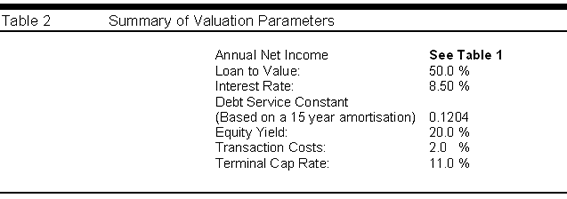
The conversion of the forecast income stream into an estimate of value is accomplished by using a Discounted Cash Flow procedure. In general, many valuers tend to use an overall discount rate, which is meant to represent both the cost of debt and equity capital explicitly. However, the methodology employed by HVS estimates the value by using the individual discount rates that are specifically required by debt and equity components. To accomplish this task, members of HVS International have developed a valuation formula referred to as The Simultaneous Valuation Formula (SVF). The formula uses a ten-year projection of income and expense. The net income is then discounted through a mortgage-equity procedure that allocates the anticipated net income and reversion to the mortgage and equity components based on market rates of return and loan-to-value ratios. The total of the mortgage component and the equity component equals the value of the property. The following four steps detail this process:
|
|||||||||||||||||||||||||||||||||||||||||||||||||
|
|
|||||||||||||||||||||||||||||||||||||||||||||||||
|
|
However, the annual debt service and result to equity cannot be calculated without knowing the property's total value, the very unknown that we are attempting to calculate. In essence, the property's value must be estimated by using an iterative process to calculate the mortgage amount that the net income is capable of supporting as the assumed interest rate and the specified loan-to-value ratio. Using our computerised mortgage-equity model (the SVF) to perform the necessary calculations produces the following estimate of value for the subject hotel: The Total Property Value as indicated by the Income
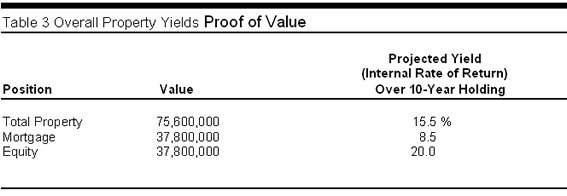
Capitalisation Approach is (SAY) US$75,600,000. |
||||||||||||||||||||||||||||||||||||||||||||||||
|
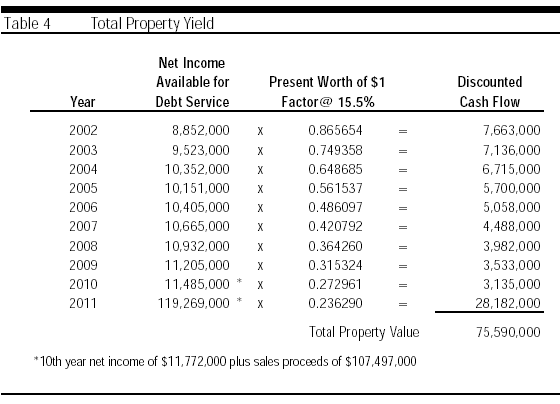
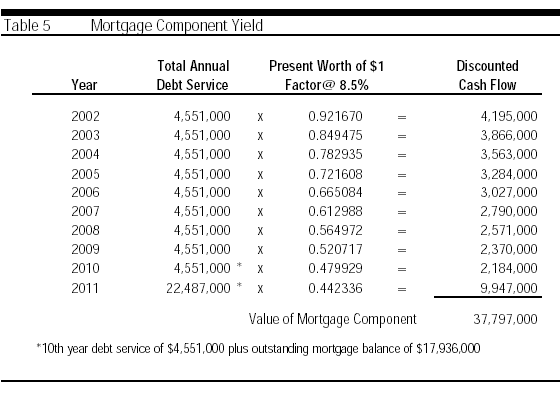
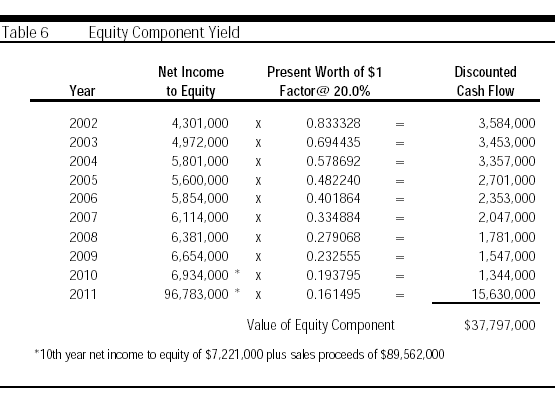
Calculating the yields for the mortgage and equity components during the projection period proves the value. If the mortgagee achieves a 8.50% yield and the equity yield is 20.0%, then $75,600,000 is the correct value by the income capitalisation approach, which amounts to approximately US$220,000 per room. Using the assumed financial structure set forth in the previous calculations, value can be allocated between the debt and equity as follows: Mortgage Component (50%) 37,800,000 The annual debt service is calculated by multiplying the mortgage component by the mortgage constant. Mortgage Component 37,800,000 The cash flow to equity is calculated by deducting the debt
service from the projected net income before debt service. The equity residual
at the end of the 10th year is calculated by taking the 11th year's net income
and capitalising it with the terminal capitalisation rate to arrive at the gross
sales proceeds. Subtracted from this figure are the outstanding mortgage balance
plus brokerage and legal fees to arrive at the net sales proceeds. The overall
property yields (unleveraged), the yield to the lender and the yield to the
equity position have been calculated, with the results shown in Table 3, below.
|
|||||||||||||||||||||||||||||||||||||||||||||||||
|
|
|||||||||||||||||||||||||||||||||||||||||||||||||
|
|
Tables 4 to 6, overleaf, demonstrate that each of the capital
components actually receive their anticipated yields, proving that the
US$75,600,000 estimate is correct, based on assumptions adopted in this
approach. |
||||||||||||||||||||||||||||||||||||||||||||||||
|
|
|||||||||||||||||||||||||||||||||||||||||||||||||
|
|
|||||||||||||||||||||||||||||||||||||||||||||||||
|
|
|||||||||||||||||||||||||||||||||||||||||||||||||
|
In the instance of an acquisition or refinancing exercise of an existing resort, it is likely that a new buyer or lender would deduct a capital expenditure amount to represent the cost required in order to either: Maintain the market position of the resort in the competitive market; Or reflect a refurbishment programme that is required in order to refurbish and reposition the resort within the competitive market. A prudent valuer would deduct any capital expenditure
amounts, as considered necessary, from the value to arrive at the likely
purchase price that a potential buyer would pay in light of any necessary
capital improvements. However, for this case study, we have not made any capital
expenditure deductions. |
|||||||||||||||||||||||||||||||||||||||||||||||||
|
Resort values in Asia have historically been estimated based
on replacement cost, comparable sales transactions or various direct
capitalisation approaches. In view of the volatile nature of resorts’ cash
flows, the valuer can employ the Discounted Cash Flow approach, which reduces
the risk associated with resort investments. As extensive market research is
conducted and comparable evidence gathered via this approach, the valuer is able
to accurately reflect the future earning potential of the resort and the market
rates of return of active equity investors and debt providers. Furthermore, the
Discounted Cash Flow approach reflects the investment thinking of active
knowledgeable buyers and sellers of resorts in Asia. |
|||||||||||||||||||||||||||||||||||||||||||||||||